
Checking Clearfield County Criminal History
No single search produces a complete Clearfield County criminal history. Start with the free Pennsylvania Unified Judicial System docket search for filed charges, bail, outcomes, and sentences. Search both Common Pleas and Magisterial District Court records. A case may begin before one of four local magisterial judges, then move to Common Pleas if held for court. County code 17 appears in Common Pleas criminal docket numbers.
Prepare the full name, spelling variants, and birth date when known. A docket number is safer than a name because it reduces mistaken matches. Police hold incident reports, the jail holds booking and custody files, and Pennsylvania State Police maintains statewide criminal-history information. Each source answers a different question.
- Search UJS at both court levels and choose Clearfield County.
- Compare the name, birth date, court, filing date, and docket number.
- Open the docket sheet and read each charge's disposition.
- Call the Clerk for omitted documents, older files, or a certified outcome.
- Use PATCH for a state response, or the proper local agency for reports and custody facts.
Clearfield Criminal Records Stay Split
A police report, jail booking, court docket, and repository response are related, but they are not copies of one master file. DuBois Police, Clearfield Regional Police, Curwensville Police, and PSP may create incident records. Booking adds custody data. Courts record charges and proceedings. Reportable fingerprints, arrest events, and dispositions flow to the PSP Central Repository.
Timing can cause honest differences. A docket may appear before a repository update. A local report may exist even when no charge was filed. Restricted material may vanish from public view while authorized agencies retain access. Clearfield County also publishes no official jail roster, arrest blotter, warrant database, or sheriff app. Phone and counter access remain vital fallbacks.
Pennsylvania Official Background Checks
The Pennsylvania State Police runs Pennsylvania Access To Criminal History, or PATCH. A standard online name check costs $22 and needs no account. A notarized mail response costs $27, while a qualifying volunteer check may have no fee. PATCH compares supplied identifiers with Pennsylvania Central Repository files. It is not a federal search and does not provide police narratives or every court document.
Individual Access and Review is the subject-only self-audit route. It uses form SP 4-170 by mail and costs $20. Program-specific statutory fingerprint checks use IdentoGO by IDEMIA after pre-registration with the supplied service code.
The official PSP page lays out each Clearfield County criminal history option.
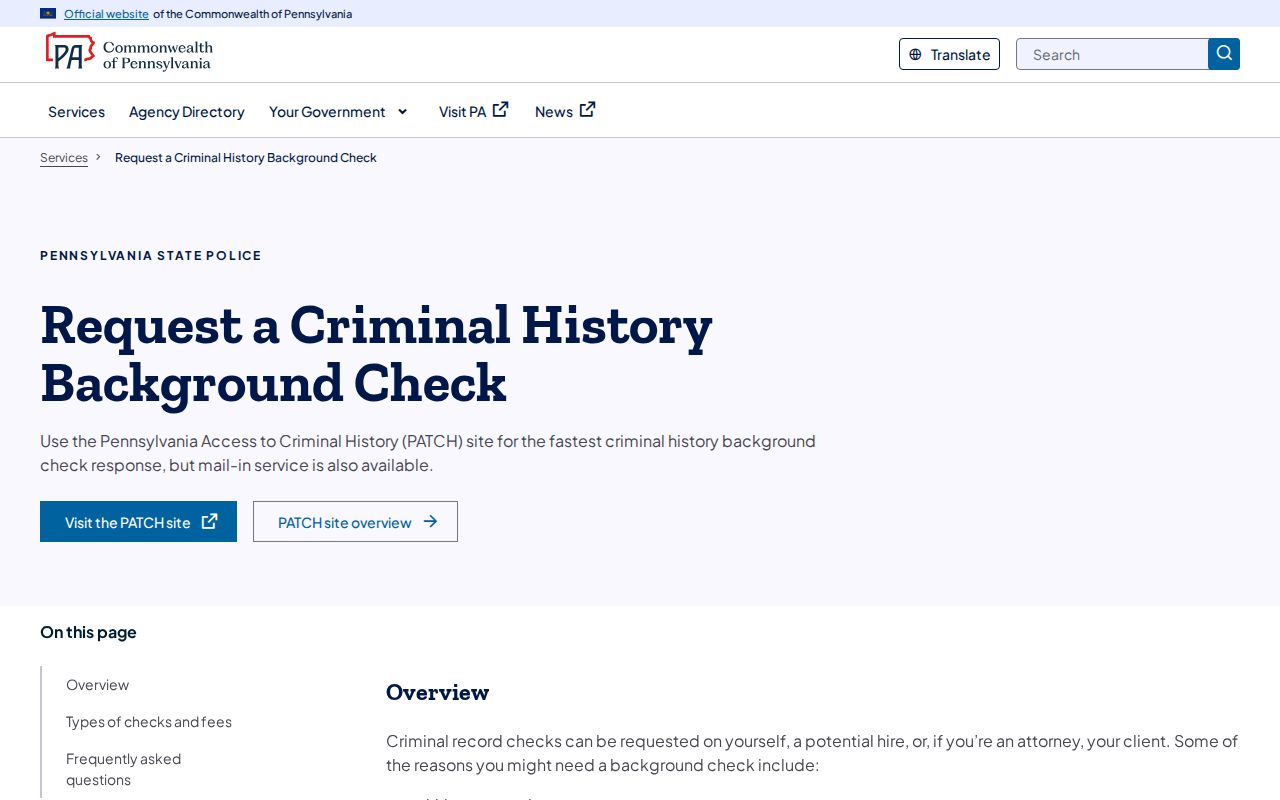
The product list separates a routine PATCH check from notarized, volunteer, and personal review requests.
Clearfield Criminal History PATCH Fields
The PATCH portal accepts new checks and later status retrieval. Nonregistered users may enter up to ten subjects in one session. The mail form requests contact data plus subject name, sex, race, aliases, Social Security number, and date of birth. Supply only accurate data. A “No Record” response does not prove no local police report ever existed. “Request Under Review” is not a finding and may take two to four weeks.
| Field | Use |
|---|---|
| Full name and aliases | Builds the name comparison and catches prior names. |
| Date of birth | Helps distinguish common-name matches. |
| Sex and race | Adds matching context from repository data. |
| Control number and request date | Retrieves a pending or completed transaction. |
The official PATCH entry screen is the direct start and status channel.
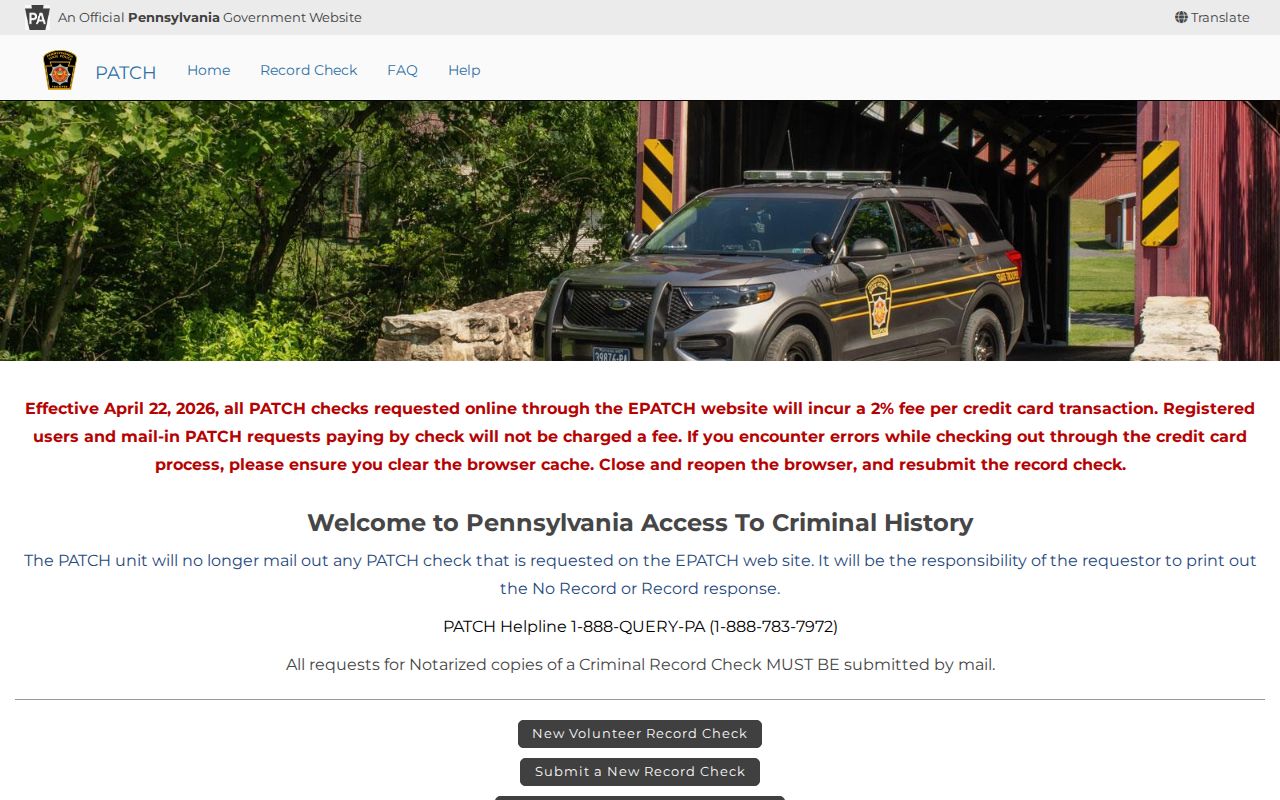
Keep the control number and request date until the response has been reviewed.
Clearfield County Criminal Record Types
Clearfield County criminal records differ by creator and purpose. An incident report describes an event. A booking record concerns custody, not guilt. A complaint begins many prosecutions before a Magisterial District Judge. A Common Pleas file can contain motions, orders, pleas, outcomes, sentences, and financial entries.
The Clerk controls Common Pleas criminal files. PSP controls statewide repository responses and the Megan's Law registry. Clearfield County Jail handles local custody data. PA DOC records apply to state-sentenced or supervised people, not those held only in the county jail.
- Incident and arrest records: request these from the police agency that handled the event.
- Booking and custody files: ask Clearfield County Jail about local detention and release.
- Court case records: search UJS, then ask the Clerk or relevant MDJ for documents.
- Warrants: use a docket as a clue, then confirm with the issuing court or Sheriff.
- Repository and supervision records: use the specific PSP, county probation, or PA DOC channel.
Clearfield Criminal Records Counters
County justice offices are concentrated in downtown Clearfield but split among separate buildings. The courthouse houses the Sheriff and Clerk of Courts. Court Administration, the District Attorney, Public Defender, and probation use the Annex. The County Records Officer works in the Administrative Offices Building. The jail stands apart on Twenty-First Street.
Clerk of Courts
1 North Second Street
Clearfield, PA 16830
814-765-2641 ext. 5013/5014
Weekdays, 8:30 a.m.–4 p.m.
Sheriff's Office
1 North Second Street
Clearfield, PA 16830
814-765-2641 ext. 5015
Weekdays, 8:30 a.m.–4 p.m.
County Records Officer
212 East Locust Street
Clearfield, PA 16830
814-765-2642 ext. 5051
Weekdays, 8:30 a.m.–4 p.m.
County Jail
115 Twenty-First Street
Clearfield, PA 16830
814-765-7891
Call for current custody procedure.
Ask for the Clerk's criminal counter rather than the Prothonotary civil counter. Call before travel to confirm access, accommodations, and copy procedure.
Inside a Clearfield County Criminal Record
A Clearfield County criminal record may connect identifiers with arrest cycles, but fields vary by source. A UJS docket emphasizes court events. A PSP history groups repository data. A booking record centers on custody. Confirm identity through several non-sensitive details, then read each charge through its final disposition.
| Name & Identifiers | Legal name, aliases, birth date, demographic identifiers, and repository numbers when applicable. |
|---|---|
| Arrest / Booking Data | Arrest date, agency, booking number, intake, bail, release, or transfer. |
| Charges & Statutes | Offense text, statute citation, grade, count, and filing court. |
| Disposition | The result for each charge, such as dismissal, acquittal, nolle prosequi, or conviction. |
| Sentence | Custody, probation, fines, costs, restitution, and concurrent or consecutive terms. |
| Custody / Supervision Status | County jail status, state custody, county probation, or PA DOC supervision. |
A charge remains an accusation until resolved. The Clearfield County criminal court case file gives the clearest chronology for filed charges.
Clearfield Criminal Record Fallbacks
Clearfield County offers no official online inmate roster. Call the jail for current custody, or use PA SAVIN/VINELink for release, transfer, or escape alerts. Do not use the PA DOC locator for someone held only in the county jail. The Commonwealth tool excludes county inmates.
No county warrant-search database was found. A UJS docket may show a bench-warrant event, but confirmation should come from the issuing court or Sheriff. A person resolving their own possible warrant should call counsel or the proper office for instructions. Never approach or try to detain another person.
The official PA DOC locator page explains its state custody scope.
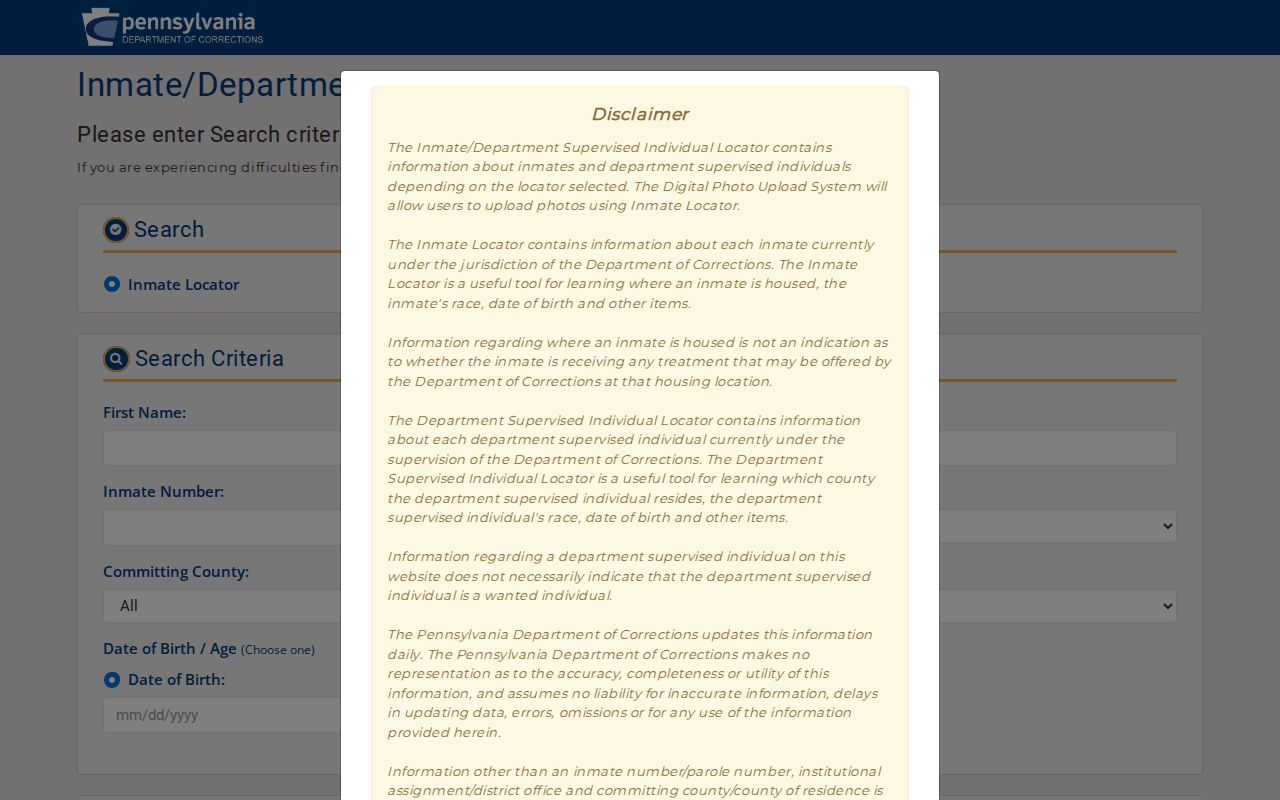
The locator assists with state-sentenced or Department Supervised Individuals, but cannot fill the county roster gap.
Note: An arrest, booking, or warrant entry is not a conviction and should be checked against the final court disposition.
Pennsylvania Criminal Record Access Laws
Access depends on the record and custodian. The Pennsylvania Right-to-Know Law governs many agency records, but does not override criminal-investigation, juvenile, privacy, or other lawful limits. Judicial files follow the UJS Case Records Public Access Policy. The Criminal History Record Information Act, or CHRIA, controls repository information and law-enforcement dissemination.
Key Statutes:
RTKL §§ 703 and 901 require a specific written request and generally allow five business days for the first response.
18 Pa.C.S. § 9121 places general requested dissemination with PSP and limits other justice agencies.
18 Pa.C.S. § 9122 governs eligible expungement and repository treatment.
204 Pa. Code § 213.81 sets public access rules for Pennsylvania case records.
A five-business-day response limit is not a guaranteed release date. An agency may extend review, redact protected facts, or issue a written denial with an appeal route.
Clearfield Criminal Records Requests
General county requests go to Open Records Officer Marianne Sankey at the Administrative Offices Building. The Clearfield County Right-to-Know page links the form and routing details. Describe the record with enough detail and provide a name and response address. Purpose usually need not be stated. Court case documents go to the court custodian under UJS policy, not through the general county form.
| County item | Published charge |
|---|---|
| Photocopies, 11+ pages | $0.15 per page |
| CD | $5 each |
| Postage | Actual cost |
| Certified copy | Additional cost; amount not stated |
| Prepayment | May be required when expected fees exceed $100 |
Criminal-investigative-record denials route to the District Attorney as designated appeals officer. Other RTKL appeals generally go to the Pennsylvania Office of Open Records within 15 business days.
The official county page shows the request channels and fee guidance.
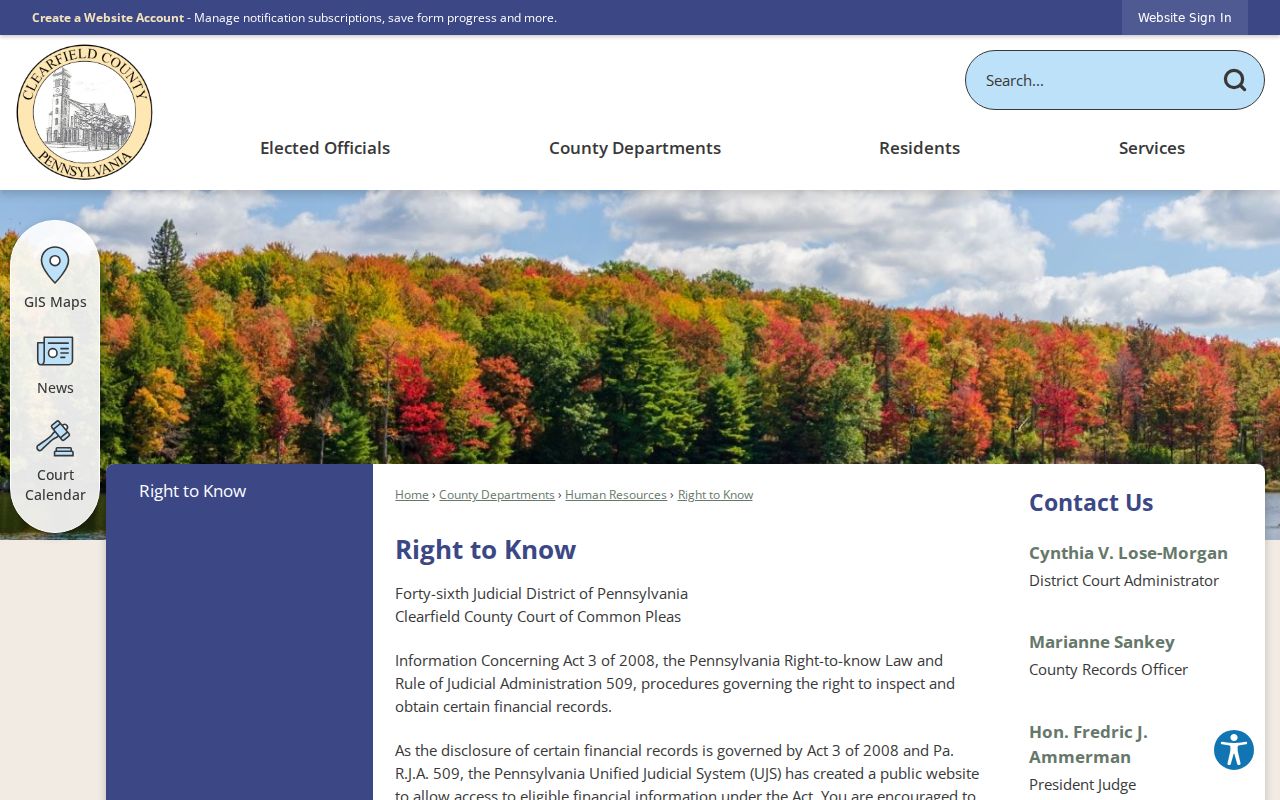
The process does not make sealed court material or exempt police evidence public.
Sealed, Expunged, and Restricted Records
Pennsylvania treats expungement and limited access as different remedies. Expungement under 18 Pa.C.S. § 9122 removes or destroys eligible records in defined cases. Limited access under §§ 9122.1 and 9122.2 blocks qualifying information from general public view without erasing every agency copy. Clean Slate supplies automatic limited access for qualifying matters.
Clearfield's Clerk publishes distinct petition materials for ARD, Magisterial District, and Common Pleas matters. ARD means Accelerated Rehabilitative Disposition, a pretrial diversion program. Completion can support expungement, but does not erase all records by itself. File with the Clerk, not the general County Records Officer, and confirm the current fee at extension 5013.
Eligibility turns on the statute, case result, age, elapsed time, and other facts. Certain summary convictions may qualify after the required arrest-free period. Defined age or death provisions also exist. A pardon is a separate executive remedy and may create a later path to judicial expungement, but it is not itself an expungement order. Juvenile, mental-health, victim, minor, and personal identifier material has separate protections. Never infer that a blank public search means an unrestricted file does not exist.
Clearfield ARD Records Cross Agencies
The county's 2024 ARD expungement order shows why clearing a criminal record takes more than one database change. The form uses the CP-17-CR case sequence, notes successful ARD completion and paid obligations, then directs certified service to offices holding parts of the case.
Recipients can include the District Attorney, Clerk, Adult Probation, PSP, arresting agency, Magisterial District Judge, jail, and other repositories. If PSP lacks a disposition, obtain the certified outcome from the Clerk and follow the state challenge route. A docket clerical error instead uses the UJS correction process.
- Expungement
- Court-ordered removal or destruction of an eligible record.
- Limited access
- A restriction on public access while defined users may retain access.
- Disposition
- The final result of a charge or case.
- Nolle prosequi
- A prosecutor-approved termination of a charge without trial, subject to court process.
Note: A missing search result may reflect sealing or limited access, not proof that no protected record exists.
Clearfield Cases Cross Four Districts
Clearfield County's broad geography splits the first steps of a case among Magisterial District Courts in DuBois, Clearfield, Kylertown, and Houtzdale. They handle preliminary arraignments and hearings plus summary matters. A held-for-court case moves to Common Pleas, where the Clerk maintains the county file.
Record flow: Police incident and arrest → county booking when detained → Magisterial District complaint and preliminary stages → Common Pleas filing if held for court → final disposition reported to PSP.
A DuBois case may require city police and MDJ contact before the Clerk in the county seat. UJS cuts travel, but not every docket entry includes a downloadable image. The counter and physical file remain fallbacks for public material.
The courts use different docket identifiers at the lower and county levels. Searchers often miss a case by looking only for a CP-17-CR number before the matter reaches Common Pleas. Others see a charge listed on an early docket and mistake it for the outcome. Search both levels, open the chronological docket, and match the final result to the correct count. When a listed filing has no image, ask the custodian whether the public document can be inspected or copied.
Clearfield County Criminal Records by City
Local report access begins with the agency serving the place. DuBois has city police, Clearfield Borough participates in regional policing, and Curwensville has a borough department. These communities do not operate standalone municipal criminal courts. Their cases use Pennsylvania's MDJ and Common Pleas system.
DuBois Criminal Records
About 7,510 residents · Start with DuBois Police and MDJ 46-3-01.
Clearfield Criminal Records
About 5,962 residents · Regional police and county courts keep distinct files.
Curwensville Criminal Records
About 2,565 residents · Borough Police holds local incident reports.
Clearfield Probation and State Parole
Clearfield County Adult Probation supervises county probation and county parole through the Courthouse Annex. It is reached through the county number at extension 5009. The Pennsylvania Parole Board decides state parole, while PA DOC performs field supervision. The state locator includes a Department Supervised Individual search and updates daily.
A supervision listing does not mean someone is wanted. Public conditions and details can be limited, and PA DOC warns that some self-reported facts may not be independently verified. County probation and state parole are not interchangeable records.
The underlying sentence remains in the Common Pleas docket, while current supervision data belongs to the supervising office. A county sentence may include probation or county parole after confinement. A state sentence can involve a Parole Board decision and PA DOC field supervision. Compare the sentence entry, custody source, and supervising authority before drawing a conclusion. For an urgent question about a person's own compliance, contact counsel or the named agency rather than relying on a locator label.