
Clearfield County Criminal Court Cases
Clearfield County forms Pennsylvania's 46th Judicial District. Most criminal matters begin before one of four Magisterial District Courts, or MDJs, serving DuBois, Clearfield, Kylertown, and Houtzdale. Those courts handle summary matters, preliminary arraignments, bail at the early stage, and preliminary hearings. When an MDJ finds enough evidence for a case to proceed, the charge is “held for court” and moves to the Clearfield County Court of Common Pleas. Common Pleas then handles the formal information, arraignment, motions, plea or trial, disposition, and sentence.
The Clearfield County Clerk of Courts maintains the Common Pleas criminal file. Brian Spencer's office is at 1 North Second Street, PO Box 549, Clearfield, PA 16830. The counter is open weekdays from 8:30 a.m. to 4 p.m., and the county telephone is 814-765-2641, extension 5013. Lower-court documents remain with the relevant MDJ. A CP-17-CR number identifies a Clearfield County Common Pleas criminal docket; an MDJ number points to the earlier court level.
Four Clearfield Criminal Courts Feed One
The four MDJ offices explain why one name can produce two connected docket numbers. A complaint may first appear at MDJ 46-3-01, 46-3-02, 46-3-03, or 46-3-04. If held for court, UJS links the originating docket to a new CP-17-CR file in Common Pleas. Summary matters can end at the MDJ level and never receive a CP number. A search limited to Common Pleas can therefore miss a lower-court result, while an MDJ-only search can omit the final plea and sentence.
The Clearfield County Court Administration page identifies the local judicial district and court resources. DuBois-area users often begin with MDJ 46-3-01, while Clearfield Borough matters commonly start at MDJ 46-3-02. The UJS court directory should be checked before any visit because the research confirms telephone numbers but advises verifying current MDJ street addresses. Search both levels first, then call the custodian that holds the specific paper or certified record.
The official Court Administration screen shows how Clearfield County is organized within the 46th Judicial District.
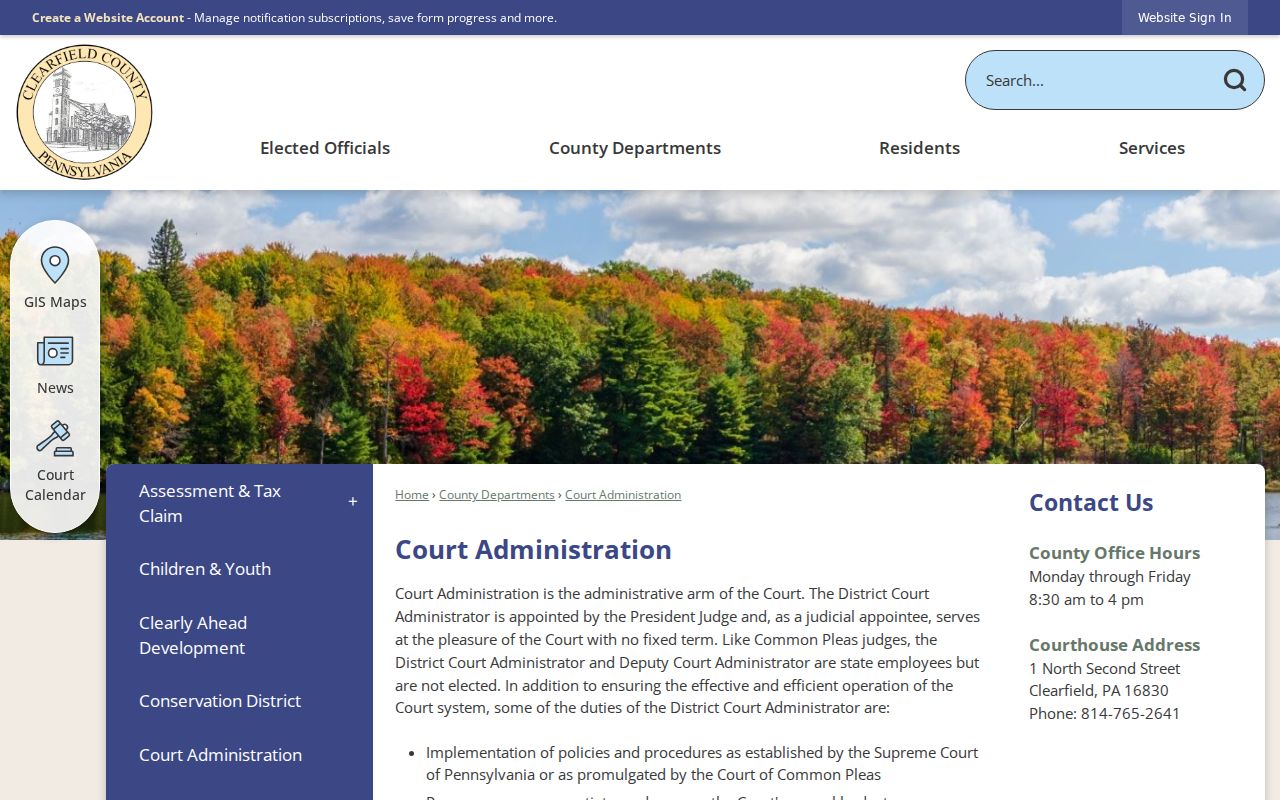
That county source is the local reference for administration, accommodations, and court operations, while UJS remains the docket-search channel.
Geography makes the handoff practical as well as legal. A person near DuBois may deal first with the local MDJ, then need a Common Pleas paper from the county seat. The filing path explains why the originating court and county code are strong matching clues. It also explains why calling only one counter can yield an incomplete answer. The lower court can address its own file, while the Clerk controls the later Common Pleas record.
Searching Clearfield County Case Records
The free Pennsylvania Unified Judicial System Public Web Docket Sheets search is the main online channel for Clearfield County criminal court cases. It requires no login or fee for public docket sheets. Search by docket number when possible. For a name search, select the correct court level, choose Clearfield County, and add a filing range or date of birth only when needed to separate similar results. The portal can list an event without offering the underlying document as a PDF.
- Open UJS CaseSearch and choose Common Pleas or Magisterial District Court docket sheets.
- Enter the full docket number, or use the participant-name search when no number is known.
- Select Clearfield County and narrow with a filing range or date of birth only as needed.
- Open the likely result and compare the caption, originating court, charges, and status before treating it as a match.
- Ask the Clerk or relevant MDJ for a document or certified disposition that the public docket does not provide.
| Field Label | Type | Required | Notes |
|---|---|---|---|
| Last Name | Text | For name search | Use the legal spelling; fewer fields can avoid false misses. |
| First Name | Text | For name search | Add middle detail only when needed to distinguish results. |
| Docket Number | Text | For docket search | CP-17-CR identifies a Clearfield Common Pleas criminal case. |
| Date of Birth | Date | No | Use for matching, but do not republish private identifiers. |
| County / Filing Range | Select / date | Varies | Choose Clearfield and a sensible year span. |
The captured UJS screen is a useful visual check of the official court selector and its search methods.
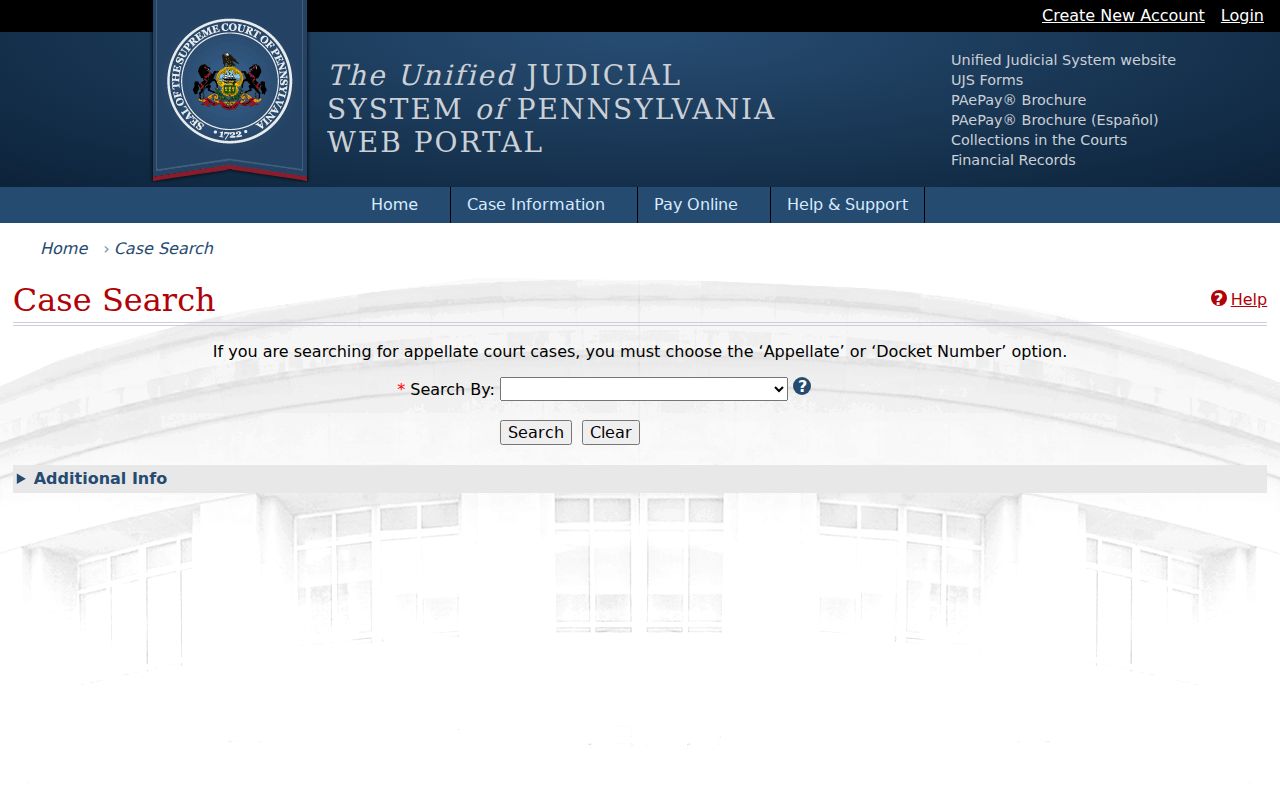
Start there for orientation, but return to the docket itself and the court custodian before relying on a result.
When the portal returns too many names, add one narrow field at a time. When it returns none, remove fields before assuming there is no public docket. A date of birth entered in a different format or an overly short filing range can suppress a useful match. Saving the exact query also gives court staff a clear account of what failed. Never move to an unofficial people-search vendor merely because the official form is exacting.
Clearfield Court Counter Adds Documents
UJS is an index and docket view, not a complete digital case folder. The Clerk counter supplies public terminals, access to available physical files, and certified copies. A docket may say that a motion, order, information, or sentencing paper was filed without presenting an image. Older or omitted documents also require a request to the Clerk, subject to the same confidentiality and redaction rules. Telephone contact helps identify the copy procedure, but a phone answer is not a certified court search.
A written judicial-record request should use the UJS Request a Record form and go to the proper court custodian. The county's general Right-to-Know form is not the route for a judicial case file. Ask for a specific docket number, document title, and filing date when known. Current copy and certification charges should be confirmed at the Clerk because the research did not verify a criminal-copy amount from the linked 2026 fee schedule.
Clerk of Courts
1 North Second Street
PO Box 549
Clearfield, PA 16830
814-765-2641 ext. 5013
Weekdays, 8:30 a.m. to 4 p.m.
The county Clerk page displays the office's current forms and access information.
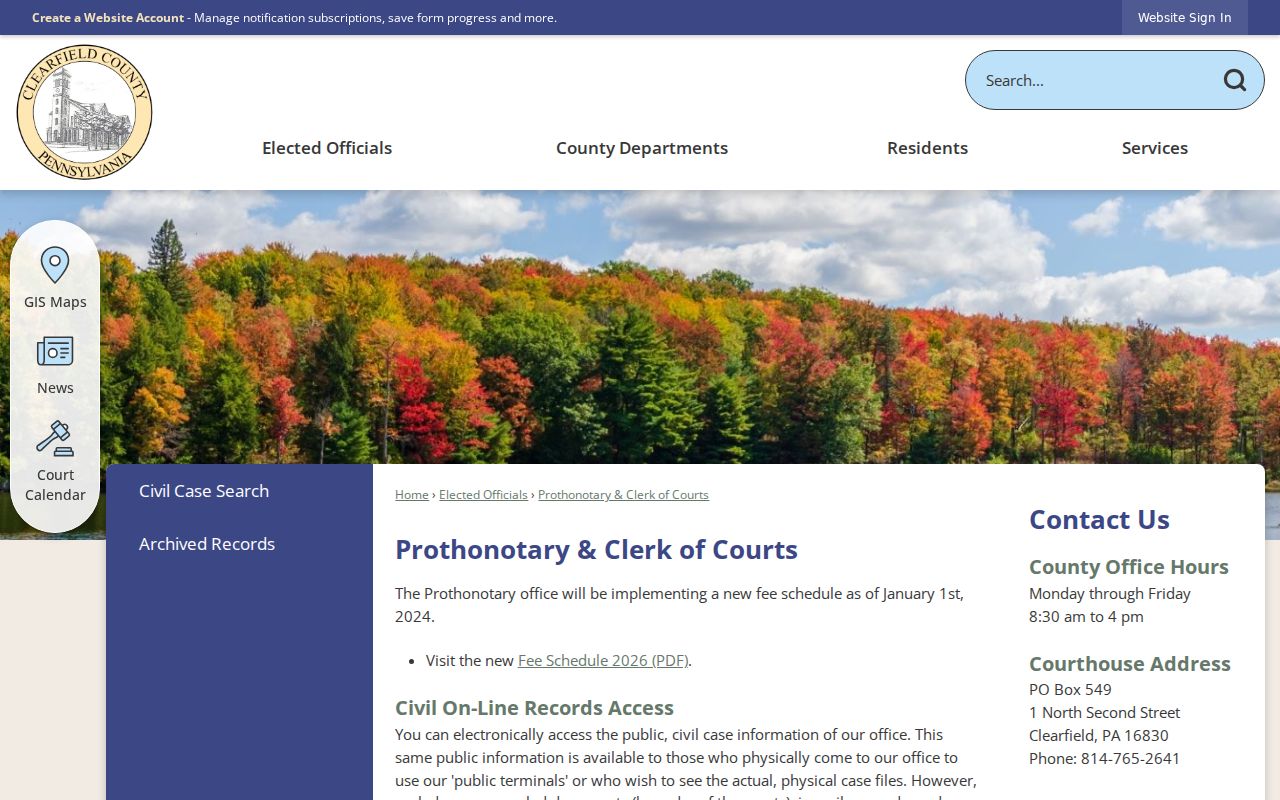
Use the criminal Clerk of Courts function, not the civil Prothonotary function, when requesting a Common Pleas criminal file.
Clearfield County's separate civil case service should not be confused with the free statewide criminal docket service. The county announced that its civil search would become subscription-only, but that change does not close UJS criminal dockets. Readers looking for charges or dispositions should remain in the criminal CaseSearch path. A certified paper request is also distinct from a repository check: certification proves the court document came from its custodian, while PATCH summarizes state repository history.
Inside a Clearfield County Case File
A Clearfield County criminal docket is a chronological court register. It can show the complaint's path, the formal information filed by the District Attorney, hearings, motions, plea or trial events, each charge's disposition, sentence, and financial obligations. It may also record bail changes, a bench warrant, probation or parole violations, and closure. Availability differs by case, so an empty document link should not be read as an empty file.
| Case Number & Court | Shows the CP-17-CR or MDJ identifier, Clearfield County, court level, caption, filing date, status, and assigned judge. |
|---|---|
| Charging Document | Identifies the complaint or formal information, statute, grade, count, and originating docket. |
| Docket Entries | Lists filings and court actions in date order, even when the filed paper is not downloadable. |
| Hearing Dates | May show scheduled proceedings, date, time, judge, and courtroom. |
| Disposition & Judgment | Reports the result of each charge, such as guilty, acquitted, dismissed, withdrawn, or nolle prosequi. |
| Sentence & Conditions | Records the court-imposed term, probation or confinement details, restitution, costs, and related financial entries when posted. |
Read Clearfield Court Results Carefully
A filed charge is an accusation. It does not establish guilt. Read across to the disposition for each count rather than stopping at the charge list. “Dismissed” means the court ended that charge without a conviction. “Withdrawn” means it was taken back at that stage. “Nolle prosequi” records a prosecutor-approved termination through court process. An acquittal is a not-guilty result, while a conviction follows a guilty plea or adjudication.
- Bail
- Conditions used to secure appearance while a Clearfield County case is pending.
- ROR
- Release on one's own recognizance without monetary bail.
- Disposition
- The recorded outcome of a charge or case.
- Information
- The formal Common Pleas charging paper filed by the District Attorney.
- Bench warrant
- A judge's command, often entered after failure to appear.
Identity needs equal care. A common or misspelled name can produce a false match or no match. Compare the caption, county, court level, originating MDJ, and non-sensitive case context. Do not publish a date of birth or other private identifier. If the docket looks wrong, use the UJS clerical-correction route for a court error. A PSP repository error follows a different process and may require a Clerk-certified disposition.
Financial entries can also be misunderstood. An assessed amount shows what the docket records, not necessarily what remains due at the moment a saved copy is viewed. Bail amount is likewise not the case result. It records release conditions during a pending stage. Read the event date and later actions before interpreting either field, then confirm a current balance or certified status through the Clerk when accuracy matters.
Note: A UJS screen print can orient a search, but only the Clerk can provide a certified Clearfield County Common Pleas disposition.
How a Clearfield Criminal Case Moves
A police complaint normally reaches an MDJ first. The preliminary arraignment addresses the complaint and bail. At a preliminary hearing, the MDJ decides whether the Commonwealth has shown a prima facie case, meaning enough evidence for the charge to continue. A held-for-court matter then receives a Common Pleas docket. The District Attorney files the information, formal arraignment follows, and pretrial conferences or motions shape the next step. The matter can end through withdrawal, dismissal, a negotiated plea, or trial. Conviction then leads to sentencing.
Case flow: Charges Filed › Arraignment › Pretrial › Plea or Trial › Disposition › Sentencing
Clearfield County research does not support a fixed time for each stage. Hearing schedules, motions, continuances, and case complexity differ. Use the docket's proceedings list for dates and confirm changes with the court. A newly entered UJS event may also appear before PSP receives the final disposition, which is one reason the court docket and PATCH response can differ for a time.
The docket's status should be read with its last entry. “Active” can cover several pending stages, and “closed” does not explain whether the outcome was dismissal, plea, acquittal, or sentence. A bench-warrant entry may arise long after the first complaint and can alter the next court step. Follow the chronology through the final listed action, then ask the Clerk when a recent order has not yet appeared or the wording remains unclear.
Clearfield Court Requests Follow UJS Policy
Judicial case records follow the Case Records Public Access Policy of the Unified Judicial System, not the ordinary county RTKL process. That distinction matters when a clerk denies access or asks for a court form. General county records go through the Pennsylvania Right-to-Know Law, but a criminal docket, order, or motion remains a judicial record held by the court custodian.
PATCH is different again. The Pennsylvania State Police product compares supplied identifiers against the Central Repository. It does not deliver hearing history, motions, docket entries, or document images. For a case outcome, use UJS and the Clerk. For state repository history, use PATCH. For an incident narrative, ask the arresting agency. Choosing the custodian by record type prevents a broad request from landing at an office that does not possess the file.
The same rule applies to appeals and corrections. A denial involving a judicial case record follows the court policy and the notice supplied by the custodian. A general agency record uses its own Right-to-Know route. A clerical mistake on the docket goes through UJS correction procedures, while an incorrect state history record goes to PSP. Keeping those paths separate makes the request easier to identify and gives the responding office enough detail to act.
Access rule: Court files use UJS policy; a general Right-to-Know request cannot override sealed material, protected identifiers, or judicial confidentiality rules.
Certify a Clearfield Criminal Disposition
A certified disposition is the court custodian's official copy of the recorded outcome. Begin with UJS to identify the complete CP-17-CR or MDJ number, then contact the office holding that file. Tell the Clerk which document and charge result are needed. A generic request for every paper can cost more and take longer to prepare, while a docket number, document title, and filing date let staff identify the item. Confirm the current copy and certification fee before sending payment because the research did not verify a criminal-copy amount from the 2026 schedule.
Certification is not the same as notarization of a PATCH response. The Clerk certifies a court record. PSP produces the repository response and offers its own notarized mail product. When a final outcome is missing from Pennsylvania criminal history, the certified court disposition may support the subject's correction request to PSP. Keep the original record, note when it was obtained, and send it only through the official review channel.
Before contacting the counter, separate the outcome needed from the full history of the case. A sentencing order may answer a sentence question, while the docket sheet shows the whole chronology and the disposition section reports the result by charge. If a lower-court charge never moved to Common Pleas, the MDJ remains the likely custodian. If the UJS result links an originating MDJ docket to CP-17-CR, use both numbers in the request. This lets staff distinguish two connected files from two unrelated proceedings.
Ask how the office accepts requests and payment before mailing anything. The research confirms counter, telephone, and written court-record channels, but it does not support a promise that any specific document can be emailed or prepared the same day. Confidentiality review, archive retrieval, and certification can affect the response. A screen image is enough for early research; a Clerk-certified paper is the stronger source when an official outcome must be shown or used to correct one's own repository history.
Case Record Access and Restrictions
Public access does not make every page visible. Juvenile matters, sealed records, mental-health records, victim and minor identifiers, Social Security numbers, financial account numbers, and confidential-information forms can be withheld or redacted. Online views may expose less than the lawful paper file. A missing result may reflect restricted access, a search mismatch, an MDJ-only matter, or a case that has not yet reached Common Pleas. It is not proof that no case exists.
When a Clearfield County criminal court case does not appear, save the exact spelling and court level used. Try the docket number, reduce overly exact filters, and search both MDJ and Common Pleas dockets. Then call the Clerk or originating MDJ and ask whether a public file exists and what request form applies. Certified copies come from the custodian. For the broader county records landscape, the Clearfield County criminal history overview explains why police, jail, court, and repository records can show different facts.
Redaction can also create a lawful gap between the online docket and a counter response. Statewide policy protects full Social Security numbers, financial account data, confidential forms, and sensitive information about victims and minors. A clerk may provide a redacted public copy even though the unredacted paper exists in the court file. Sealed, juvenile, and mental-health material falls outside ordinary public access. Describe the exact public record sought, and do not ask staff to disclose protected identifiers.
Restricted public access should also be kept distinct from expungement. Limited access can remove qualifying information from general public view without destroying every government copy. Expungement addresses eligible records through a court process under Pennsylvania law. The Clearfield Clerk publishes separate forms for ARD, Magisterial, and Common Pleas cases, so the correct filing depends on the underlying docket. Completion of ARD does not by itself prove that every related record has already been expunged. Court orders must reach the agencies and repositories identified in the local process.
If an online result once existed and later disappears, do not reconstruct it from cached or commercial copies. Recheck UJS and ask the court custodian about public availability. A lawful restriction, sealing order, correction, or search change can alter what the public sees. The official court and repository channels are better sources than stale copies because they preserve the current legal status and reduce the risk of tying a record to the wrong person.
For historical or genealogy work, give the Clerk a clear date span and every known docket clue. Older material may not have the same online depth as a recent Clearfield County criminal court case. The counter can explain whether a public index, terminal, or physical file is the right source. Avoid asking the office to search an unlimited set of names or years. A focused request is easier to locate, price, review for restrictions, and return in the form actually needed.
Note: A restricted or sealed docket can lawfully disappear from public view while authorized justice agencies retain access under Pennsylvania law.