
Sex Offender Checks in Clearfield County
The Pennsylvania Megan's Law Public Website is the authoritative source for a Clearfield County sex offender search. Pennsylvania State Police maintains it under the Commonwealth's registration laws. Searches are free and require no account. No separate Clearfield County sheriff registry or local offender map was found in the official research, so the county filter on the PSP site is the correct local starting point.
Choose a mode that matches the question. A county search surveys public listings tied to Clearfield County. Municipality narrows that set to DuBois, Clearfield, Curwensville, or another named place. Name search works best when a person is known, while ZIP and address-radius tools support neighborhood awareness. School or day-care proximity and wanted or transient categories may also appear. Each result is a lead to read, not proof of a violation.
The official Clearfield County filter is shown in the captured registry search form.
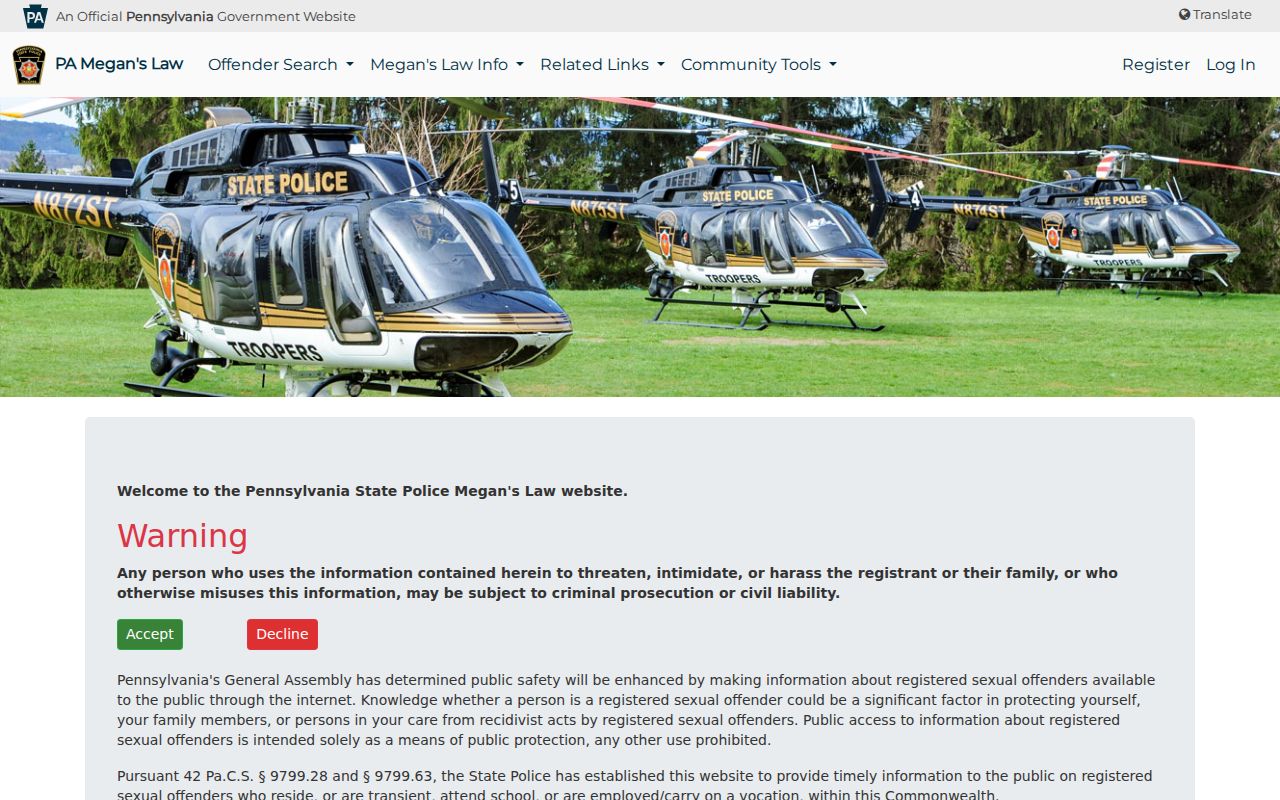
Selecting Clearfield sets the geographic scope, while the optional municipality control can make the result set more precise.
Choose a Clearfield Registry Search Mode
Name, county, municipality, ZIP, and radius searches answer different safety questions. Start with the least restrictive useful field. If the spelling of a surname is uncertain, use fewer name controls or an available Soundex or partial-name option. For a place, county provides broad context, municipality narrows it, and an address-radius search centers on a specific location. Geocoding can be imprecise, so a pin is not proof that the profile text is wrong or that a residence rule has been broken.
| Question | Best Mode | Check Next |
|---|---|---|
| Is a known name listed? | Name search | Open the full profile and compare aliases and conviction jurisdiction. |
| Who is publicly listed in the county? | County=Clearfield | Narrow by municipality when useful. |
| What appears near one place? | Address and radius | Read the address text instead of relying on the map pin. |
| Could the listing be in another state? | NSOPW | Follow the result to the responsible jurisdiction. |
Note: Registry geography supports awareness and planning, but it does not establish a person's location at a particular moment.
How to Search Pennsylvania Megan's Law
PSP publishes several entry points within the Pennsylvania Megan's Law Public Website. Begin with the county control for a broad Clearfield County registry search, or use the name screen when identity is known. Read and follow the site's conditions of use. Search results can appear as a list or map, with profile and paging controls that vary by device.
- Open the PSP registry and review its conditions and warning.
- Select name, county, municipality, ZIP, or address search, then supply only the fields that fit the question.
- Review the result list or map without treating a similar name or nearby pin as a confirmed match.
- Open the full profile and read the offense, jurisdiction, address text, status, tier, registration period, and verification information together.
| Field Label | Type | Required | Notes |
|---|---|---|---|
| Last Name | Text | Principal name input | Soundex or partial controls may appear; reduce fields if uncertain. |
| First Name | Text | No | Use to narrow a surname result. |
| Municipality / ZIP | Select / text | For those modes | Municipality narrows a Clearfield County search; ZIP must be exact. |
| County | Select | For county mode | Select Clearfield. |
| Address / Radius | Text / map control | For radius mode | Street, city, state or ZIP and radius support mapped proximity. |
The official name-search image shows why it helps to begin with the fewest reliable identity fields.
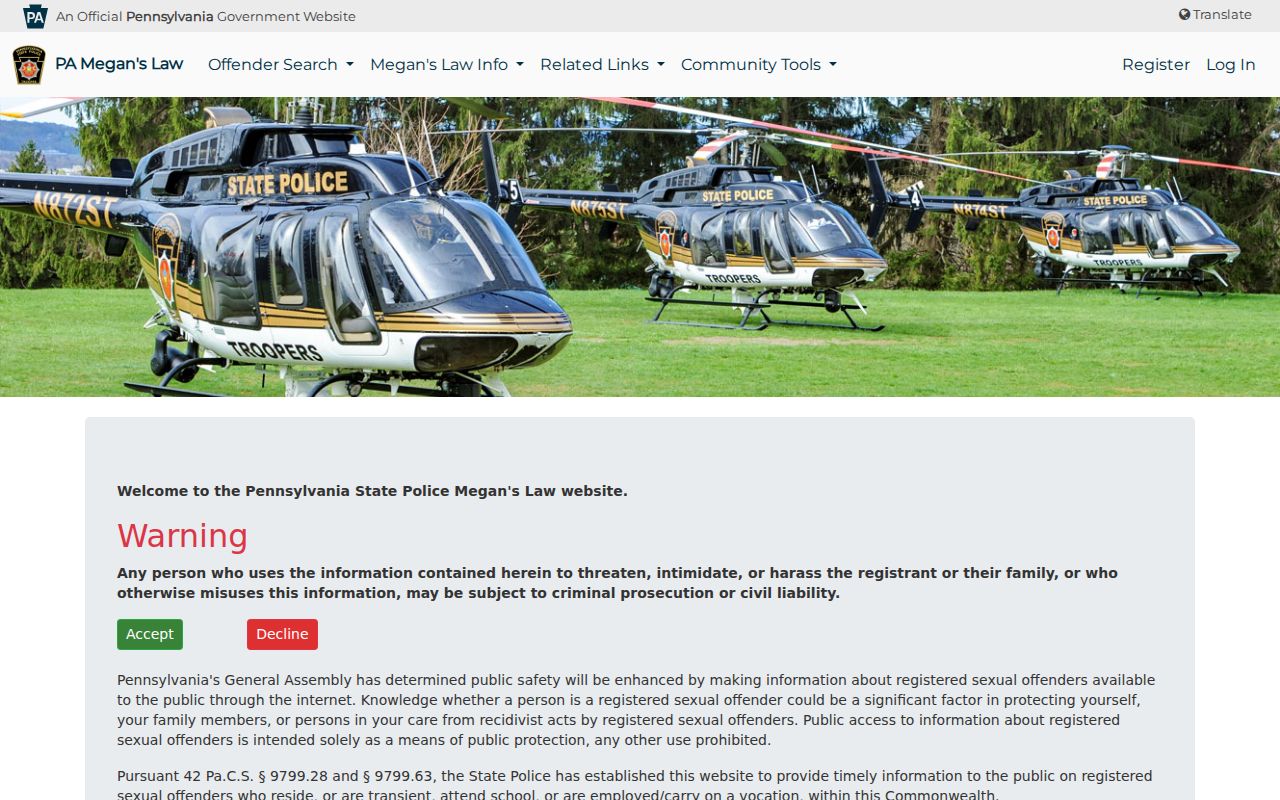
The search controls locate possible profiles; the profile content must still be checked before drawing a conclusion.
Search buttons and map controls can differ on a phone or desktop, yet the evidence check stays the same. Compare the profile's full name, aliases, conviction jurisdiction, and public status fields. Similar names alone are not enough. If a result set is broad, narrow by Clearfield County or municipality. If a precise query misses, remove optional filters and try again before concluding that no public listing exists.
Clearfield Map Pins Need Context
An address-radius result depends on geocoding, the process that converts address text into a point on a map. A pin can be offset or generalized. School and day-care proximity also does not prove a statutory residence violation. Pennsylvania duties turn on the governing offense, classification, status, and law, not on a reader's estimate from a screen.
Open the result and read the stated residential or transient address, work or school details when public, registration status, and verification notes. If the text appears inaccurate, report it to PSP rather than confronting anyone. For an immediate emergency, call 911. For suspected bad registry data or absconder information, contact the Pennsylvania State Police Megan's Law Unit at 1-866-771-3170.
Location labels also carry different meanings. A residential address, transient designation, work location, and school entry should not be treated as interchangeable. Multiple addresses or vehicles may appear when the statute makes them public. Read the label attached to each value. That extra step is more sound than drawing a broad conclusion from the first point on a result map.
Inside a Registry Profile
A public profile joins identity, location, conviction, and registration data. Read all four groups. The name and photograph help with identity, while aliases and physical traits can separate similar results. Address, vehicle, work, or school information appears only as Pennsylvania law makes it public. The offense and conviction jurisdiction explain the legal basis, and the tier or pre-SORNA category explains the general registration framework. Compliance and verification data describe registry administration, not guilt in a new case.
| Name & Aliases | Legal name and reported alternate names used to distinguish a profile. |
|---|---|
| Photo & Physical Description | Photograph, sex, race, height, weight, hair and eye color, age, and reported scars, marks, or tattoos. |
| Registered Address | Residential or transient addresses, sometimes with public work, school, and vehicle information. |
| Offense & Statute | Description, statute, conviction or adjudication date, and jurisdiction. |
| Level / Tier | Tier or pre-SORNA category and the stated registration period. |
| Registration Status | Compliance or absconder information and verification details when displayed. |
The PSP FAQ screen provides the agency's own explanations of public use, updates, and compliance information.
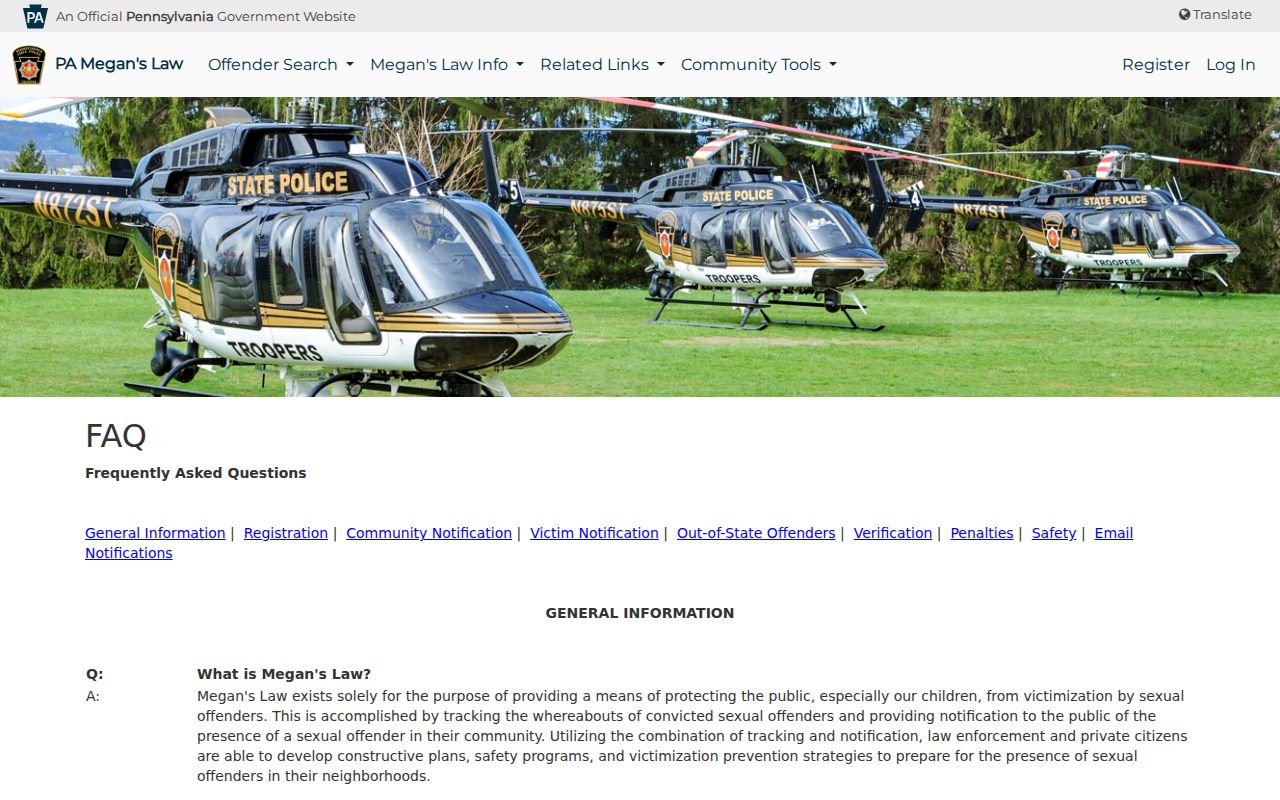
Those official notes are essential when a field seems stale or a status label is unclear.
Physical-description fields help distinguish identities, but they should not be copied into a neighborhood list or social post. The registry already provides the official context and current status notes. Use the least amount of detail needed for a safety decision, then return to PSP when a value is unclear. A profile can display more than one photograph, address, or vehicle, so several values do not by themselves show noncompliance.
Clearfield Profiles Can Follow Different Laws
Two profiles with similar plain-language offense descriptions can show different registration periods because Pennsylvania's framework changed over time. Megan's Law began in 1995. Public Internet access expanded in 2004. The Adam Walsh and SORNA framework took effect in 2012, and Act 10 of 2018 addressed pre-2012 conduct after constitutional rulings. Current Subchapter H tiers coexist with a Subchapter I or pre-December 20, 2012 framework.
Do not infer a tier from a charge name alone. Exact offense, conviction facts, dates, statutory exceptions, and court history control. The profile's category and registration period are more reliable than a guess based on a similar case. When the court case behind a listing matters, the Clearfield County criminal court case search can provide docket context, but PSP remains the registry custodian.
The change in law is also why a simple ranking from least to most serious can mislead. Tier and duration reflect statutory rules, not a public risk score made by the searcher. Pre-2012 categories may use a different legal track even when a description resembles a current-tier offense. Read the displayed regime and period, and leave legal classification questions to the official record and qualified counsel.
The official registration page lays out the statutory categories and periods used by the registry.
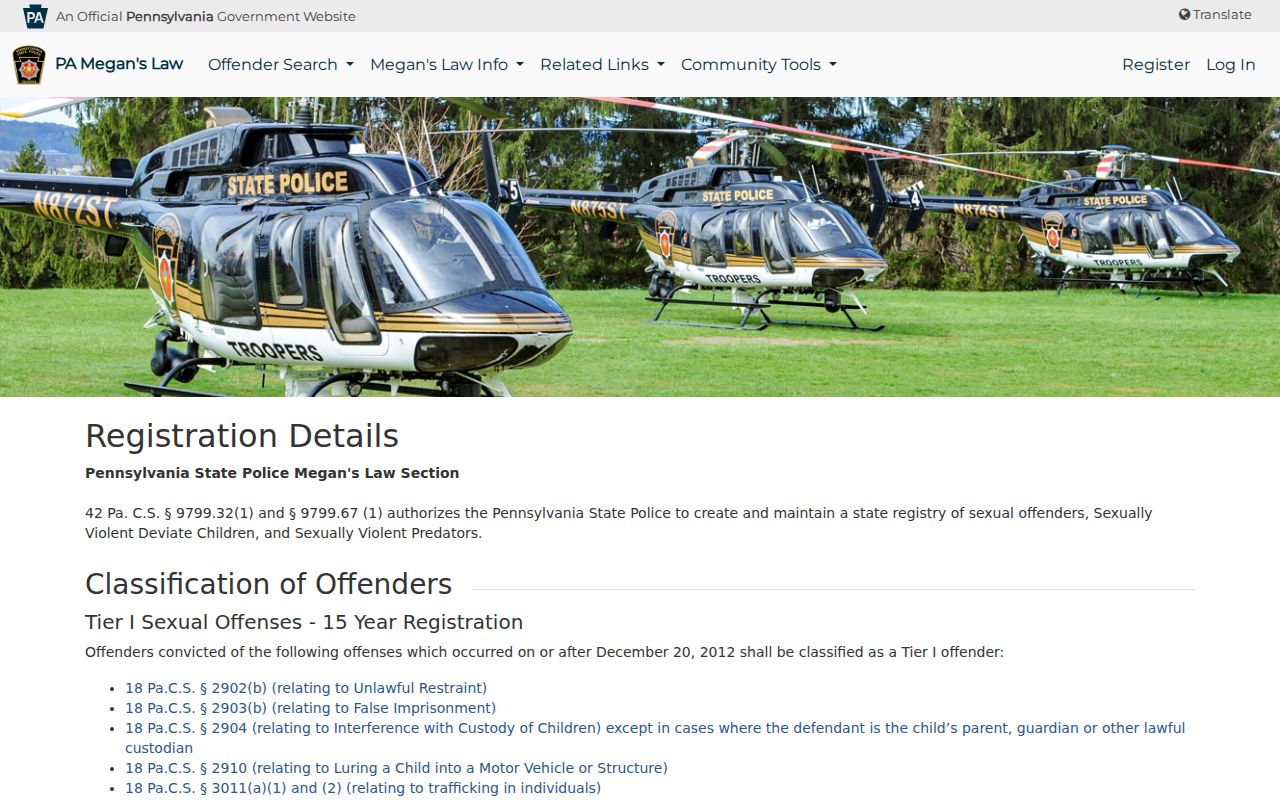
Reading that framework beside the individual profile helps avoid treating all listings as legally identical.
Pennsylvania Registration Levels and Requirements
Pennsylvania's general Subchapter H scheme uses three tiers, with longer periods and more frequent verification at higher tiers. Sexually Violent Predator status carries a lifetime period and an enhanced notification framework. Some conduct predating December 20, 2012 follows Subchapter I and may carry ten-year or lifetime registration. These are general rules only. The exact offense and exceptions control the duty shown on a profile.
Verification frequency describes how often a registrant generally must report under the applicable classification. It does not promise that every displayed field changes on that same timetable. A reader should look for the profile's own verification and update information. If an address or status appears inconsistent, PSP's unit is the correction channel. The public should not try to test compliance through contact, surveillance, or a visit.
| Level / Tier | Duration | Verification Frequency |
|---|---|---|
| Tier I | 15 years | Generally annual |
| Tier II | 25 years | Generally semiannual |
| Tier III | Lifetime | Generally quarterly |
| Sexually Violent Predator | Lifetime | Quarterly, with enhanced notification |
| Subchapter I / pre-2012 category | 10 years or lifetime | Governed by the Act 10 framework |
Clearfield Search and NSOPW Differ
The Pennsylvania registry is best for a Clearfield County question because PSP controls the Commonwealth's profile fields and update notes. The U.S. Department of Justice National Sex Offender Public Website, or NSOPW, adds a cross-state layer. It is useful when a person or location may cross Pennsylvania's border, but it points users back to the participating jurisdiction rather than replacing that jurisdiction's record.
Use both tools with the same careful matching method. Begin with the most reliable name or place detail, open the source profile, compare conviction jurisdiction and aliases, and read the update notes. If NSOPW finds a record maintained elsewhere, follow that state's official link. If the concern stays within Clearfield County, return to PSP for the authoritative Pennsylvania listing and accuracy contact.
The national search screen is the official supplement for a question that extends beyond Pennsylvania.
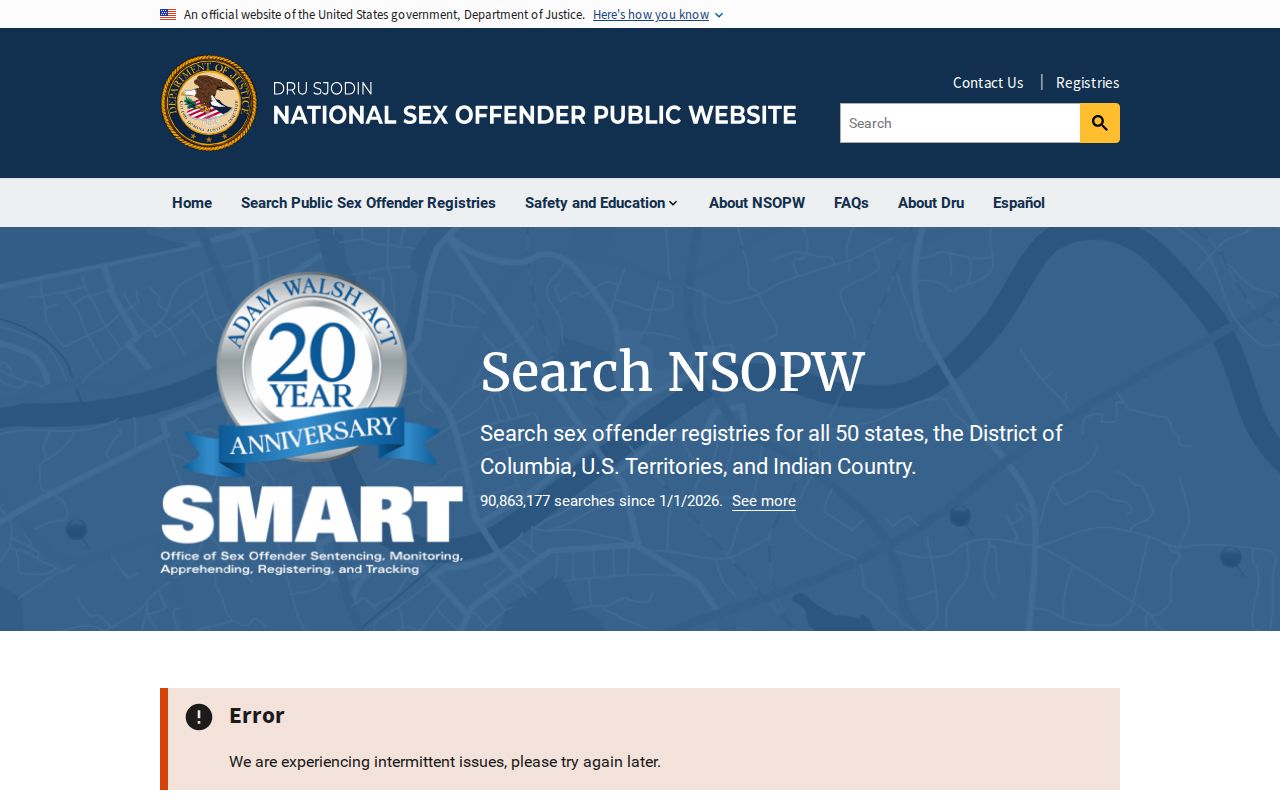
Its value is breadth across jurisdictions; the underlying state profile still supplies the controlling local detail.
NSOPW may show differences in field names or availability because each jurisdiction supplies its own public data under its own law. That is expected. Do not merge two entries merely because the names resemble each other. Open each source profile, compare the public identity fields, and use the responsible state agency's contact channel when an update or correction is needed.
For someone moving between Clearfield County and another state, run the Pennsylvania search and the national search separately. Record which jurisdiction supplies each profile. The national layer improves reach, but it cannot settle a Pennsylvania classification question or correct PSP data. The agency named on the source profile remains responsible for its record, warning language, and update process.
Correct a Clearfield Registry Concern
Do not confront a person when a Clearfield County registry entry seems wrong. First reopen the full profile and distinguish the map pin from the address text. Check the status, jurisdiction, verification detail, and any multiple addresses. Save the official URL and note the date. Then call the PSP Megan's Law Unit at 1-866-771-3170 to report suspected inaccurate information or absconder information. The registry is informational and is not an emergency-reporting system.
A missing result also needs restraint. Not every sex offense or person is currently registrable or publicly displayed, and absence from the registry is not a general background check. UJS may help explain a Pennsylvania court case, but a docket and a registry profile serve different purposes. Call 911 only for an emergency. Use the PSP unit for the accuracy and compliance channel documented by the registry.
A court docket may list the charge history and outcome, yet it will not replace the registry's current administrative status. Conversely, the registry profile does not reproduce every motion, plea event, or sentencing paper from the case file. Use each official system for its own purpose. That distinction is especially important when an older Pennsylvania case falls under a pre-2012 registration framework.
Make the report specific. Give PSP the public profile URL, the field that appears inaccurate, and the date it was viewed. Do not circulate the disputed value while waiting for review. The unit can assess registration and compliance data because PSP maintains the site. Local police remain the right call for immediate conduct or danger, but they do not replace PSP as the statewide registry custodian.
Preserve context without copying the profile into a new public record. Note the search mode, Clearfield County filter, page URL, and the label beside the questionable field. A map marker and address line are different fields, so state which one appears wrong. If the concern involves identity, describe the mismatch without sending more personal information than PSP requests. This focused report gives the registry unit a clearer issue to check and limits needless circulation of sensitive data.
Compliance and accuracy are also separate questions. An address that looks unusual may reflect a transient status, multiple lawful addresses, or a map conversion issue. An absconder label is an official status, but a private reader should still report information rather than try to locate or detain anyone. PSP and police have the authority and current records needed to assess the report. The public search supports awareness; it does not transfer enforcement powers to searchers.
Note: Date any saved registry result and revisit the official profile because verification timing differs by classification and status.
Community Notification and Lawful Use
Registry information supports personal safety, family planning, and community awareness. The public fields and notification framework come from Pennsylvania's registration statutes, including 42 Pa.C.S. Subchapters H and I. Use the profile to understand the statutory listing, then rely on law enforcement for suspected noncompliance. A map result is not authority to investigate, visit, follow, or contact a registrant or household.
Misuse is prohibited: The PSP registry warns that threatening, intimidating, or harassing a registrant or family, or otherwise misusing registry information, can lead to criminal prosecution or civil liability under Pennsylvania law.
Responsible use also means protecting private data encountered during a search. Do not republish birth dates, addresses, photographs, vehicle details, or other profile fields merely to discuss a result. Share urgent facts with the proper authority. For a routine safety review, return to the official profile to ensure that the status remains current.
Community awareness works best when facts stay tied to their official context. Discuss safety plans without labeling a person beyond what the current PSP profile states. Do not treat an address search as permission to approach a residence. If conduct appears threatening or urgent, report the conduct through emergency or police channels. If the concern is only whether a listing is accurate, use the Megan's Law Unit number and let PSP review its data.
The registry's warning protects both the community and listed households. Safety steps can include reviewing an official radius result, setting family boundaries, and contacting police about observed conduct. They do not include threats, public shaming, or attempts to drive someone from an address. Keep conclusions within the facts PSP publishes, and check the profile again before acting on a saved or shared result.
A practical family review can stay factual and calm. Search the relevant address or municipality, open each likely profile, and discuss the public facts without speculation. Teach children or vulnerable relatives general safety rules that do not depend on confronting a listed person. If a profile describes a school or work location, read the label and statutory context before interpreting it. Return to the official search for later checks because a screenshot can become outdated.
Public notification is not a complete measure of risk. Pennsylvania law determines which people and fields appear, and the system does not list every past offense or every person who may pose harm. Combine registry awareness with ordinary personal safety measures. Report actual threats or suspicious conduct through the proper police channel. Treat a no-result search as only that: no matching public listing under the fields used at that time.
When sharing a safety concern with relatives or neighbors, link to the current official PSP page instead of copying a profile. The source page keeps the warning, status, and legal context together and can reflect later updates. State what the registry actually says, not what a map seems to imply. If the information supports an urgent report, provide it to police. If it raises a data question, send it to the Megan's Law Unit. Those channels preserve accuracy and reduce harmful misuse.